CaribLit
News, Information, Resources for Caribbean Publishing
  • Home
  • About
    • Member Directory
  • Directory
    • Directory Search
  • Blog
  • Book Club
  • Photos
  • Survey
  • Links
  • Contact

Working the Roots: Cuba’s Ocean Sur Press Mines Politics and Revolution for Publishing Profit

21/2/2013

 
Picture
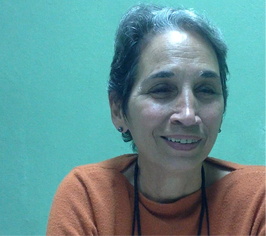
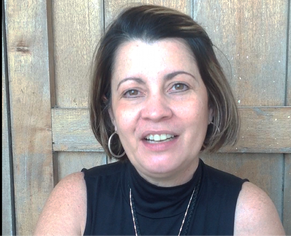
Yvonne Muñiz, Ocean Sur Press
From its tiny base in Cuba, Ocean Sur Press has generated an impressive catalogue of more than 300 titles in just seven years. A spin-off of the Australian publisher, Ocean Press, Ocean Sur publishes books on Cuban history and politics, including the writings of Che Gevara and Fidel Castro. The company now generates strong sales in Cuba, particularly to the large market of tourists and sells well throughout Latin America, the United Kingdom and the United States. It’s US distribution network now spans more than 2,000 bookstores. It has also been able to parlay its book rights into films including Motorcycle Diaries, the 2004 film directed by Walter Salles and Steven Soderbergh’s 2008 film, Che: The Argentine/Guerilla.

Ocean Sur’s catalogue also includes titles on Latin American thinking, politics and revolution, including books on Chile’s Pablo Neruda and Martinique’s Franz Fanon. The company also publishes books under its Open Memories category, which commemorates the lives of freedom fighters and leading thinkers around the world, such as Malcolm X, Martin Luther King, Helen Keller and Albert Einstein.

Ocean Sur’s Yvonne Muñiz, a former art critic with a background in Caribbean art, thinks there are strong opportunities for publishers from the English-speaking Caribbean to mine the politics and history of the region in similar ways.

“In the Caribbean, you have to work the roots,” says Muniz. “You have to start with the history. You have to go against the many myths that have been imposed on the Caribbean. You usually find information on the beauty of the Caribbean. But behind that there is a history that needs to be written and rewritten.

“We should go back to our first thinkers. The topic of race is very important in our culture. There are histories that have been put into silence. The world is not aware of the cultural richness of our countries in the Caribbean.”

Muñiz thinks that the rise in electronic readers and tablets give Caribbean publishers the opportunity to package new works on history, politics and culture in fresh and interesting ways.

“We live in a world of images,” she says, calling for publishers to integrate major texts with relevant photography and illustrations. “Vernacular architecture, ruins, paintings, traditions, cuisine --  all are attractive to other markets. Colour is important. Covers are important.”

Muñiz notes that maintaining an active, current website and supporting social media platforms is critical for Caribbean publishers who wish to reach the international audience. She also recommends generating a regular newsletter and sending Advance Information sheets to distributors for all new releases.

“Caribbean content sells,” says Muñiz. “Our countries are very much loved by people around the world. There are many niches that have not yet been exploited.”

Translation provided by Vladimir Dominguez. Learn more about Ocean Sur Press.

Negotiating Rights for Caribbean Authors in International Markets

21/2/2013

 
Picture
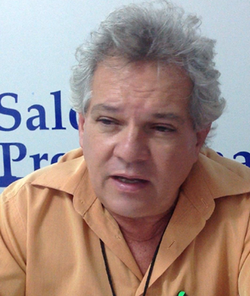
Daniel Garcia Santos
CaribLit talks to Daniel Garcia Santos, Director of the Latin American Literary Agency

Talk to anyone in the Caribbean publishing industry and the absence of a literary agency is high on their list of challenges. In fact, the creation of a regional literary agency was one of the recommendations that emerged at the first meeting of the Caribbean Literature Action Group in Port of Spain in 2012.

One potential model for what such an agency would look like is the Agencia Literatura Latinoamericana (Latin American Literacy Agency), an arm of the Instituto Cubano del Libro (Cuban Book Institute). It was created in 1985 to represent the rights of Cuban authors. The objectives of the agency are to promote Cuban literature abroad and to represent authors in negotiations with foreign publishers. Cuba has had a national copyright law since 1977 and is a signatory of the copyright conventions of the World Trade Organization.

With a small staff of seven, including four experts in copyright law, promotion and representation, the agency represents the rights of the authors and facilitates the payments of their royalties. It undertakes a year-long programme of activities designed to identify new opportunities for writers – tracking trends in publishing in existing and emerging markets for Spanish-language literature, analysing the catalogues of international publishers and watching their moves to identify those who may be interested in Cuban authors. It develops and maintains the necessary relationships with foreign publishers, introduces new Cuban authors to publishers, negotiates the most advantageous contracts for the authors and manages the payments of their royalties. 

“We maintain relationships with foreign publishers and promote groups of authors according to the genres in which they write,” says Daniel Garcia Santos, the agency’s director. “Once we identify any interest in publishing a certain work in a certain country, we negotiate with the publisher and we protect the authors’ royalties.”

The agency has a promotion catalogue which is disseminated to the international publishing community. While the Havana Book Fair is its major forum for showcasing the work of Cuban authors, it maintains an active presence at international book fairs and promotes different groups of Cuban authors according to the profile of each fair.  “We have a tradition of participating in these fairs so we understand the differences and the interests of each market,” says Garcia Santos. “If we’re going to a fair for the first time, we try to gain some minimum knowledge of the market and then try to select the right authors for that fair. We do promotion in advance so that our attendance is effective.”

Garcia Santos cites as a key example the Frankfurt Book Fair, which he calls a critical space for the promotion of literature and the negotiation of international rights. The agency participates every year.   For Frankfurt, the emphasis is on young Cuban writers who have won literary prizes and received strong critical reviews. For the Guadalajara Book Fair in Mexico, the agency prioritizes the winners of Cuba’s most important writing prizes.  

“Our agency is given top priority, because it is important to the state to promote our literature and protect our authors,” says Garcia Santos. “We try to get contracts which are as beneficial as possible for our authors. When authors negotiate individually with publishers, sometimes the negotiations aren’t as beneficial.”

The agency retains a percentage of the royalties it negotiates for its authors (to a maximum of 15%). What the agency generates over the course of a year depends on the number of contracts it’s able to negotiate, the authors signed and the genres in which they work. Garcia notes that soap opera scripts are a strong income area, generating $30,000 to $40,000 in revenue.

The agency now has a wide network of relationships with international publishers and has built deep institutional knowledge of which areas and markets are most accessible for Cuban literature.

“The international market is very difficult. Inserting yourself and Cuban authors who are not known is very difficult. We work very hard to find areas where we can insert contemporary Cuban authors. Some of our authors are very well known and the requests come. But there are many others that we have to promote.”

Garcia Santos calls for more collaboration between Spanish-speaking and English-speaking Caribbean publishers.  “Sometimes we are a little isolated. We should establish relationships among publishers across the region. We have a common culture. We should have communication channels, systems that allow us to share the knowledge we have of these areas. That’s the only way we have access to these markets which are distant and difficult. Communication is of the essence.”

When asked how other Caribbean islands can follow Cuba’s model for negotiating international rights, Garcia Santos recommends developing a Caribbean organization for driving international promotion and rights sales. “It’s difficult for the author in isolation to access this world. An institution that has a cultural interest and an interest in the promotion of our literature should make the effort.”

Translation provided by Vladimir Dominguez.


A Carnival of Books

21/2/2013

 
Picture
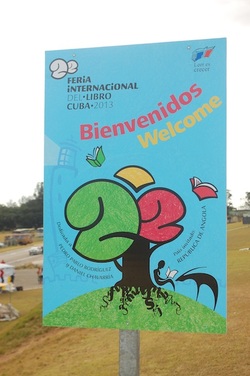
Passion meets prose at the Havana International Book Fair – the largest in the Caribbean

The numbers alone are staggering: 140+ exhibits; 100+ events per day; 400 foreign delegates from 40 countries; 11 days of book launches, readings and performances; 12 venues across the city, including the sprawling Cabaña Fortress – a massive 25-acre historic site that serves as the Fair’s hub; on average, more than 20,000 visitors per day.

And that’s just the warm-up. 

When the curtain comes down in Havana on February 24, 11 days of non-stop activity after its Valentine’s Day start, the Fair repeats its combination of book sales and supporting events on a tour through all 14 of Cuba’s provinces, culminating in Santiago de Cuba.

By the time the fair ends in Santiago de Cuba – after 30 days in total -- more than 140,000 books will have been sold and more than 1,000,000 Cubans will have come out for the event.

Picture
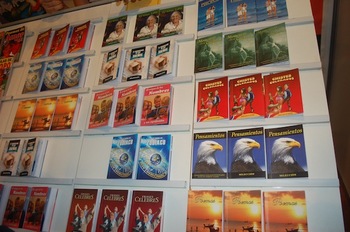
But the numbers don’t tell the whole story. The Havana Book Fair is a cultural phenomenon. Since its start in the 80s as a biennial book fair, it’s grown into a massive event – annual since 2000 – the largest on the Cuban calendar.

“Everybody [looks forward to] the book fair,” says Aida Bahr of the Instituto del Libro (Cuban Book Institute), the state agency responsible for coordinating the fair. “It’s the cultural event that gets to everyone, everywhere. Most of our books are launched at this time of year for the fair, so it’s a great opportunity to buy new books.

“It’s not just book launches and sales, but a very wide programme of activities: conferences, meetings of librarians and historians, literature and social science conferences. There are meetings with publishers to discuss important issues [as well as] meetings with foreign publishers.”

Every year the fair honours one country and two outstanding Cuban writers – a fiction writer and a social scientist.  The selections influence much of the programming. This year’s honoured country, Angola, brought a delegation of more than 100 writers, performers, academics and cultural representatives to the Fair, to showcase Angolan culture in all its forms and Cuban publishers released 18 new editions of Angolan books for the local market.

It’s the combination of new Cuban books, the opportunity to learn about other cultures and the sheer magnitude of the spectacle that draws the Cuban audience year after year for an event that feels more celebratory than cerebral. 
That’s what the Instituto del Libro and its partner planning agency the Camara del Libro (Chamber of Books) are banking on. (Yes, Cuba has a Chamber of Books, like a Chamber of Commerce; a state run agency to tend to the business of its books.  The Chamber runs logistics for the fair as well as a summer slate of book related activities during the summer holidays and manages Cuba’s participation in international book fairs.) 

“The mission of the Havana Book Fair is to give the people access to books,” explains Bahr. Jesus David Curbelo who coordinates the fair’s mammoth schedule of literary, academic and professional events notes that the mission isn’t necessarily to get people to buy books during the fair. “A lot of people come just to have fun… It’s part of our cultural tradition and [it has made] people very  interested in reading.”

The human and financial resources invested are signfificant -- the organizing committee has more than forty members and  with the staff of the Instituto del Libro and the Camara del Libro, the full team numbers into the hundreds. The budget for domestic expenses alone; i.e. salaries and things that do not have to be imported, run into the millions. But the fair isn’t expected to make a profit.  As with all books published in Cuba, the book fair itself is subsidized by the government, with the long term goal of promoting reading and strengthening Cuban culture. 

“The point of it is to make a cultural investment,” says Bahr. 

“It’s an investment in the people.”

Cuban Book Industry by the Numbers

21/2/2013

 
  • 172 publishing houses. Most are small, belong to a University or research centre and publish just a few titles every year. 
  • 30 major publishers:  14 belong to the Ministry of Culture: the rest belong to other ministries or NGOs. 
  • 7 publishing houses are run by the Instituto del Libro; each specializes in a different genre, including Arte y Literatura, devoted to publishing foreign literature. 
  • 2000+ books published per year collectively
  • One major book distributor: the National Book Distributor, belongs to the Instituto del Libro.
  • 300+ bookstores: at least one in each of the 169 municipalities. No matter how remote, each municipality has a bookstore; the larger ones have up to 15. 
  • 48 bookstores in Havana alone, selling primarily Cuban books. One chain, Ediciones Cubanas – caters to tourists and sells foreign titles.

Alba Narrativa Awards for Young Writers

20/2/2013

 
Picture
Each year at the Havana Book Fair, young writers from Latin America and the Caribbean are honoured at the Alba Narrativa awards. Since its launch in 2010, the awards have quickly become one of the most attractive awards for Spanish language writers in the region. Over 100 novels are entered each year. 

What’s less known is that the awards are open to English-language writers as well. In the four years of the contest, no English-language entries have been received. Aida Bahr, Caribbean Literature Action Group member and Vice President of Cuba’s Instituto del Libro, is hoping that will change in 2014.

Anyone under 40, born in any country in Latin America and the Caribbean, can enter. The entries must be original and unpublished novels, 120 to 400 pages, and should not be under contract with a publisher, literary agent or be simultaneously entered in another contest.

Entries are due in October of each year, and the winners are announced at the Havana Book Fair, the following February. Winners have their books published and receive USD 10,000 or its equivalent in their local currency. Each year’s winners are invited to the next year’s staging of the Havana Book Fair, where they get a chance to interact with fellow writers from the region at the fair’s Young Writers Conference.

Learn more about the Alba Narrative Awards.

Forward>>

    About the CaribLit Blog

    Commentary and insight on Caribbean publishing. Here you’ll find articles written by our action group members and other literary and publishing notables, as well as links to useful articles from other sources and coverage of literary and publishing events. We look forward to your comments.

    Archives

    February 2017
    September 2016
    May 2016
    January 2016
    December 2015
    November 2015
    September 2015
    March 2015
    February 2015
    January 2015
    December 2014
    July 2014
    June 2014
    May 2014
    April 2014
    March 2014
    February 2014
    January 2014
    December 2013
    November 2013
    October 2013
    September 2013
    August 2013
    July 2013
    May 2013
    April 2013
    March 2013
    February 2013

    Tags

    All
    Agents
    Book Fairs
    Book Festivals
    Book Policy
    Bookstores
    Canada
    Conferences
    Co Publishing
    Co-publishing
    Cuba
    Diaspora
    Distribution
    Ebooks
    Funding
    Havana Book Fair
    Jamaica
    Kingston
    Kingston Book Festival
    Latin America
    Marketing
    Prizes
    Publishers
    Rights
    Royalties
    Spanish
    Technology
    Tobago
    Translation
    Trinidad
    United Kingdom
    United States
    Writers

    RSS Feed

Twitter

Tweets by @CaribLit

Partners

© 2012 - 2013 CaribLit. All rights reserved.